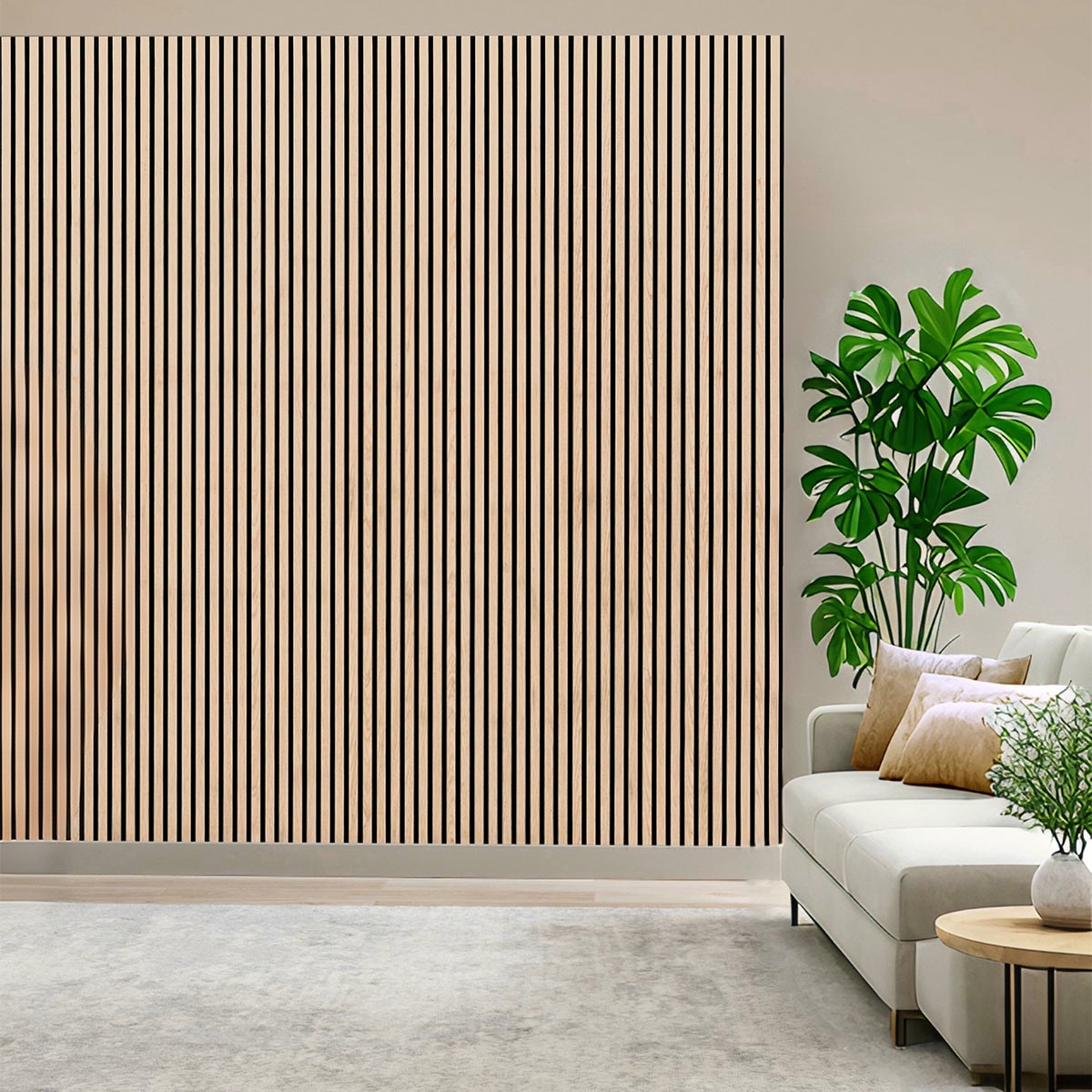
There are twenty data points on a typical acoustic panel spec sheet. If you’re specifying for a home, or a small studio, or even a thoughtful commercial fit-out, you almost certainly need to look at two of them. Maybe three. The rest is there to make the manufacturer look serious, or to satisfy a compliance officer somewhere.
We’ve installed Linea 24 in about four hundred rooms over the last two years — some ours, mostly clients’. What follows is what we wish every first-time buyer knew before they filled a basket. It’s also, deliberately, a bit opinionated.
The six specs, ranked honestly
- NRC rating. The single most useful number — and the most abused.
- Core material & backing. Determines how long the panel will last, and whether it sags.
- Fire rating. Non-negotiable for commercial; quietly important at home.
- Slat depth & rhythm. The aesthetic part. Affects acoustics far less than most people think.
- Finish & veneer. How it reads in the room. Everything here matters, but it’s all taste.
- Mounting system. The thing no-one talks about until the panels are on the floor.
1 · NRC, explained once properly
NRC stands for Noise Reduction Coefficient. It’s a number between 0 and 1 that represents how much sound a material absorbs across four octave bands — 250, 500, 1000 and 2000 Hz. An NRC of 0 is a mirror. An NRC of 1 is, theoretically, a sound-proof booth. A typical plastered wall is about 0.05. A good slat-felt panel sits between 0.70 and 0.90.
A panel rated 0.90 NRC doesn’t make a room 90% quieter. It absorbs 90% of mid-frequency sound that hits the panel itself. Cover 40% of your wall, and you’ll change the room’s reverb time noticeably. Cover 10%, and you’ll change how it looks.
Two practical rules we use: for a living room, aim for 25–35% panel coverage of one wall. For a home office, 40–60% on the wall behind the monitor. More than that and you’re in a recording booth, which sounds dead and oddly uncomfortable.
2 · The backing is what ages
Every slat panel has two halves: the veneer slats you see, and the felt backing that does most of the acoustic work. Cheap panels use virgin polyester felt. Better panels use recycled PET felt — often 60% or more post-consumer. Best-in-class use 100% recycled PET and bond it to an engineered MDF core rather than a softwood one.
Why does it matter? Recycled PET holds its density better over time. Softwood cores will warp within a British heating season if they sit on a radiator wall. Our Linea 24 uses 100% recycled PET on a class B MDF core; it’s why we can offer a 10-year guarantee without blinking.
3 · Fire rating: the room that saves you money
For a domestic living room, fire rating is a quiet virtue — you’ll never think about it until insurance does. For anything commercial, or a hallway, or a staircase, it’s the first question building control will ask.
- Class B-s1,d0 (EN 13501-1) — safe for hallways, stairwells, most commercial fit-outs.
- Class C — fine for domestic living rooms and bedrooms.
- Class D or lower — avoid.
Every Chirpi panel is tested to Class B-s1,d0. It costs us more. It’s why we can honestly say “install this anywhere” without qualifications buried three clicks deep.
4 · Slat rhythm: this is aesthetics, not acoustics
The difference between a 14 mm slat and a 24 mm slat is, in acoustic terms, almost nothing. What changes is the visual cadence of the wall. Narrow slats read as fabric; wider slats read as joinery. Pick based on the furniture, not the data sheet.
5 · Finish: the only part you’ll actually look at
Real veneer, always. Printed laminates are cheaper by £15–£20 per square metre, and every single one we’ve seen looks plausible for six months and then looks exactly like what it is. Veneer ages into its grain; laminate ages into its flaws.
Five finishes worth specifying, in the order we recommend them: Natural Oak for warmth, Black Oak for drama, Walnut for depth, Grey Oak for light rooms, Whitewashed for coastal. We stock all five at our London warehouse, pre-cut to 2400 mm.
6 · Mounting: the afternoon you’ll remember
Three options, three honest verdicts:
- Construction adhesive. Fastest, least forgiving. Good if the wall is flat and you never plan to move.
- Screws through the felt. Our preferred method. Pre-drill, use pan-head 3.5 mm, plug the holes with felt plugs from the offcuts. Twenty minutes per panel for a confident DIYer.
- Magnetic rail system. Beautiful, removable, expensive. Specify for hotels, showrooms, or clients who change their mind twice a year.
The two that really matter
If you’ve read this far and want the TL;DR: NRC rating determines how the room sounds. Backing material determines whether it still sounds that way in five years. Everything else — the slat rhythm, the veneer, the mounting — is taste and trade-off. Get those two right and the panel will earn its keep for a decade.
If this was useful, the sample pack is the next honest step. Order up to five free samples, fit them to the wall, live with them for a week. It’s how we’d buy them ourselves.